Imagine this. You just landed your dream job as a software developer. Your first task? Set up your work computer. You open the box. You feel excited. Then you realize something important. You have no idea which Windows version to pick.
You do not know how much RAM you need. You wonder if your laptop can handle Docker. This feeling is normal. Many developers face this exact problem. In fact, choosing the right Windows setup for developers can make or break your daily workflow. A bad choice slows you down for years.
A good choice boosts your speed and joy every single day. This guide solves that problem. It walks you through every decision step by step. You will learn about hardware needs. You will see software tools. You will understand licensing. You will compare laptop options. By the end, you will know exactly how to buy the best Windows for developers. Let us begin this journey together.
Understanding Windows Editions for Developers
Windows 11 comes in two main editions for most people. These are Home and Pro. For developers, the choice matters a lot. Windows 11 Home works fine for basic coding. You can run Visual Studio Code on it. You can write Python scripts. You can browse Stack Overflow. However, Home lacks key tools. Windows 11 Pro includes Hyper-V. Hyper-V lets you create virtual machines.
Developers need VMs for testing. They need VMs for isolated environments. Pro also supports BitLocker encryption. It supports Remote Desktop. It supports Group Policy controls. These features help professional developers every day.
Therefore, most developers should choose Windows 11 Pro. The price difference is worth it. You pay about $100 more for Pro. That small cost unlocks huge productivity gains. So, pick Pro if you can afford it.
Hardware Requirements for Windows for Developers
Hardware matters more than software for developers. You need a fast machine. You need lots of memory. You need fast storage. Microsoft now defines developer-class hardware. This new standard is called Project Zenith. It requires at least 64 GB of unified memory. It also demands 250 GB/s of memory bandwidth.
These specs let you run large AI models locally. You can run coding models with over 30 billion parameters. That is powerful. But not every developer needs that much. A good starting point is 16 GB of RAM. That handles most coding tasks. If you use Docker and VMs, get 32 GB. If you train AI models, get 64 GB. Your CPU should be at least an Intel Core i5 or AMD Ryzen 5. Get a recent generation. Storage should be an NVMe SSD. Aim for at least 512 GB. These specs create a solid Windows for Developers machine.
The Power of Windows Subsystem for Linux
Many developers love Linux. They love the terminal. They love bash scripts. But they also need Windows apps. WSL solves this problem beautifully. WSL stands for Windows Subsystem for Linux. It runs a real Linux kernel inside Windows. You get Ubuntu, Debian, or other distros. You run Linux commands without leaving Windows.
This is a game changer for Windows for Developers. WSL 2 is the current version. It uses a real Linux kernel. It provides full system call compatibility. You can run Docker containers inside WSL 2. Docker Desktop works great with WSL 2 as its backend. You get faster cold starts. You get dynamic memory allocation. You get better file system performance. To use WSL 2, you need Windows 11 or Windows 10 version 2004 or higher. You also need virtualization enabled in your BIOS. WSL 2 requires at least WSL version 2.1.5 for Docker. So, always update WSL to the latest version.
Docker and Containers on Windows for Developers
Docker changed how developers build software. Containers package apps with all dependencies. They run the same everywhere. This consistency saves hours of debugging. On Windows, Docker Desktop is the main tool. It uses WSL 2 as its engine. This setup gives near-native Linux container performance. You can run Linux containers on Windows without a full VM.
The integration is smooth. You install Docker Desktop. You enable the WSL 2 based engine. Then you run docker commands from any Windows terminal. Memory management is smart. Docker only uses the CPU and memory it needs. This leaves resources for your other apps.
For Windows for Developers, Docker is almost essential today. Most modern apps use containers. So, plan for Docker in your setup. Give it enough RAM. 32 GB is a comfortable amount for heavy container work.
Choosing the Right Processor for Development
Your CPU is the brain of your machine. For development, you need strong single-core speed. You also need enough cores for parallel tasks. Compiling code uses many cores. Running tests uses many cores. Running VMs uses many cores. Intel Core i7 and AMD Ryzen 7 are great choices. They offer 8 to 12 cores. That handles most workloads well. If you do heavy AI work, consider Core i9 or Ryzen 9. These chips have more cores and higher clock speeds. They cost more money.
But they save time on long builds. Also, look for a chip with AI acceleration. New chips have NPUs for AI tasks. Project Zenith hardware uses AMD Ryzen AI Halo. This chip is built for local AI development. So, if AI coding is your focus, look for these new chips. For most Windows for Developers, a mid-range CPU is enough.
Memory and Storage: The Developer’s Lifeline
RAM is where your code lives while running. Too little RAM slows everything down. Your IDE stutters. Your Docker containers crash. Your browser tabs freeze. Therefore, get as much RAM as you can afford. 16 GB is the minimum for Windows for Developers. 32 GB is the sweet spot. 64 GB is for AI and heavy VM work. Also, check if your laptop allows RAM upgrades. Some laptops solder RAM to the board.
That means you cannot upgrade later. So, buy enough RAM upfront. Storage matters too. You need fast SSD storage. NVMe SSDs are much faster than SATA SSDs. They load projects quickly. They speed up builds. Get at least 1 TB of storage. Development tools take up space. Docker images take up space. Node modules take up space. A 512 GB drive fills up fast. So, invest in a 1 TB NVMe SSD.
Best Laptop Options for Windows for Developers
Laptops are the main tool for most developers. You need a good keyboard. You need a sharp screen. You need long battery life. You need enough ports. Several laptops stand out in 2026. The MSI Prestige 16 AI Evo offers a 4K OLED screen and great battery life. It costs under $1,500. The Lenovo ThinkPad E14 Gen 5 is a budget champion. It has a legendary keyboard and Thunderbolt 4.
The Lenovo ThinkPad X1 Carbon Gen 13 is a premium choice. It is light and powerful. The Dell XPS 16 has a stunning display. The HP ZBook Power 16 G11 is a mobile workstation. It handles heavy workloads. The Asus ProArt P16 is great for creative developers. It has a Ryzen AI 9 chip and RTX graphics. Choose based on your budget and needs. For Windows for Developers, keyboard quality is often the top priority.
Desktop Builds vs. Pre-Built Systems
Some developers prefer desktops. Desktops give more power for less money. You can upgrade parts easily. You can add more RAM later. You can swap the GPU. You can add more storage. This flexibility is valuable for Windows for Developers. You can build a powerful machine for $1,500. A laptop with similar specs costs $2,500 or more. However, desktops are not portable.
You cannot take them to a coffee shop. You cannot work from a coworking space. Pre-built desktops are also an option. They save time on assembly. But they often use cheap parts. They often include bloatware.
Project Zenith PCs are a new option. They come ready to code. They include preinstalled tools like Visual Studio Code and GitHub Copilot. But they require high-end hardware. They start at around $4,000. That is expensive. For most developers, a custom desktop or a good laptop is better.
Essential Developer Tools for Windows
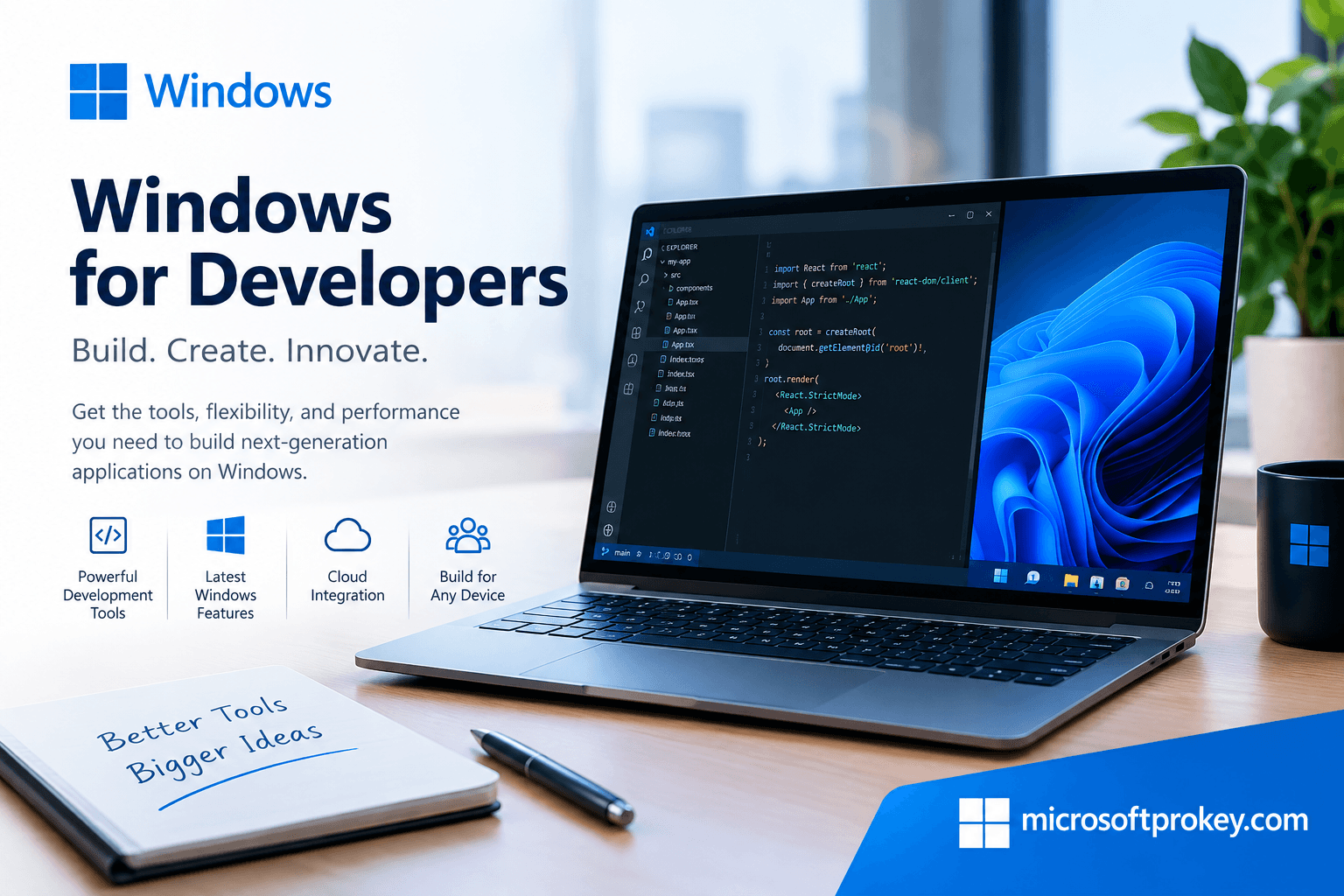
Windows now includes many built-in developer tools. You do not need to install everything manually. Windows Terminal is a modern terminal app. It supports multiple tabs and panes. It works with PowerShell, Command Prompt, and WSL. WinGet is the Windows Package Manager. You can install apps from the command line. You can update them easily. Microsoft PowerToys adds useful utilities. It includes a color picker and a keyboard manager. Visual Studio Code is a lightweight code editor. It supports almost every language.
GitHub Copilot adds AI code suggestions. Windows Developer Configurations set up your entire environment with one command. This command installs Git, PowerShell 7, WSL, and VS Code. These tools make Windows for Developers much easier. You spend less time configuring and more time coding.
Microsoft ProKey for Affordable Windows Licenses
Windows 11 Pro costs about $199 from Microsoft. That price is high for many developers. You can find cheaper options online. However, be careful. Some cheap keys are illegal. They may stop working later. They may not activate properly. A safe alternative is Microsoft ProKey. They offer genuine Windows for Developers at lower prices.
You can visit https://microsoftprokey.com/ to explore their options. They provide legitimate product keys. These keys activate Windows fully. You get all Pro features. You get Hyper-V. You get BitLocker. You get Remote Desktop. This is important for Windows for Developers. So, if budget is tight, consider Microsoft ProKey. Always verify the seller’s reputation first. Read reviews. Check refund policies. A genuine license is worth the small extra cost.
Setting Up Your Development Environment
Once you have your hardware, set up your software. First, install Windows 11 Pro. Then, update everything. Install all Windows updates. Then, install WSL 2. Run wsl –install in PowerShell. This installs Ubuntu by default. Then, install Windows Terminal from the Microsoft Store. Then, install Docker Desktop.
Enable the WSL 2 backend. Then, install Visual Studio Code. Add your favorite extensions. Then, install Git. Configure your username and email. Then, install WinGet. Use it to install other tools. Then, configure a Dev Drive. A Dev Drive uses ReFS for better performance. It speeds up builds and file operations. These steps create a powerful Windows for Developers environment. You can also use Windows Developer Configurations for one-command setup. This saves time and ensures consistency.
Security Considerations for Developer Machines
Security is critical for developers. You store source code on your machine. You store API keys. You store database passwords. A breach can be devastating. Windows 11 Pro includes strong security tools. BitLocker encrypts your entire drive. If someone steals your laptop, your data stays safe. Windows Defender provides real-time antivirus protection. It is free and effective.
Windows Hello adds biometric login. You can use your face or fingerprint. Hyper-V provides VM isolation. You can test suspicious code in a VM. It cannot harm your main system. For Windows for Developers, these features are essential. Always enable BitLocker. Always use a strong password.
Always keep Windows updated. Also, be careful with third-party tools. Download from official sources only.
Performance Optimization Tips
Your machine should run fast. Slow builds kill productivity. Several tweaks help. First, disable unnecessary startup apps. They slow down boot times. Second, use an SSD for your OS and projects. Never use a hard drive. Third, enable Hardware-Accelerated GPU Scheduling. It improves graphics performance.
Fourth, increase your page file size. This helps when RAM runs out. Fifth, use Dev Drive for your project folders. Dev Drive reduces antivirus scanning overhead. It speeds up file operations significantly. Sixth, keep your drivers updated. GPU drivers matter for AI work. Seventh, close unused browser tabs. Chrome and Edge eat RAM. For Windows for Developers, these small changes add up. They create a smoother experience. You will notice the difference every day.
Future-Proofing Your Developer Setup
Technology changes fast. What works today may not work tomorrow. So, future-proof your setup. Buy more RAM than you need today. You will need it later. Choose a CPU with AI acceleration. AI coding tools are growing. Get a laptop with Thunderbolt 4 or USB4. These ports support fast Windows for Developers।
They support external GPUs. Choose a machine with upgradeable storage. You can add more SSDs later. Choose Windows 11 Pro. It has features Home lacks. It supports Hyper-V and WSL 2 fully. Also, consider Project Zenith devices. They come ready for local AI development. They have preinstalled tools. They have optimized settings. They will become more common. For Windows for Developers, future-proofing saves money. You avoid buying a new machine too soon.
FAQ’s
Q1: Do I need Windows 11 Pro for development?
Yes, Windows 11 Pro is strongly recommended. It includes Hyper-V for virtual machines. It includes BitLocker for encryption. It includes Remote Desktop. These features are essential for professional Windows for Developers.
Q2: How much RAM do I need for Windows development?
You need at least 16 GB for basic coding. Get 32 GB if you use Docker and VMs. Get 64 GB if you train AI models. Project Zenith requires 64 GB of unified memory.
Q3: Can I use Docker on Windows 11 Home?
Yes, you can run Docker Desktop on Windows 11 Home with WSL 2. However, Windows containers require Pro or Enterprise editions. Linux containers work fine on Home with WSL 2.
Q4: What is Project Zenith?
Project Zenith is Microsoft’s ready-to-code Windows 11 experience. It comes on developer-class hardware. It includes preinstalled tools like VS Code and GitHub Copilot. It requires 64 GB RAM and 250 GB/s bandwidth.
Q5: Is a cheap Windows Pro key safe?
It depends on the seller. Some cheap keys are illegal or stolen. They may deactivate later. Use trusted sellers like Microsoft ProKey. They offer genuine licenses at fair prices.
Conclusion
Choosing the right Windows for Developers setup is a big decision. It affects your daily work for years. This guide covered every major factor. You learned about Windows 11 Home vs. Pro. You learned about hardware needs. You learned about WSL 2 and Docker. You learned about laptops and desktops. You learned about tools and security. You learned about Microsoft ProKey for affordable licenses.
You learned about Project Zenith. You learned about future-proofing. Now, you have the knowledge to decide. Start with Windows 11 Pro. Get at least 32 GB of RAM. Use an NVMe SSD. Install WSL 2 and Docker.
Choose a laptop with a great keyboard. Use Microsoft ProKey to save money on your license. Remember, the best Windows for Developers is the one that fits your workflow. Do not overspend. Do not underspend. Find the balance. Your future self will thank you. Happy coding!