Windows activation is a crucial step for every PC user. It verifies that your copy of Windows is genuine. It also unlocks all the features of the operating system. Without proper activation, you face many restrictions. You cannot change your desktop wallpaper. You see a constant watermark on your screen. That is why knowing the right Windows Activation Methods is so important. There are several ways to activate Windows today. Each method serves a different type of user. Some methods are for home users.
Others are for large businesses. Some activations are permanent. Others need renewal every few months. This guide will explain every major Windows Activation Methods in simple terms. We will cover HWID, KMS, MAK, OEM, and Retail keys. We will also show you how to pick the best one. Moreover, we will explore how Microsoft Teams helps teams collaborate. You will learn real-world use cases for Teams. By the end, you will know exactly what to do. You will also know where to buy genuine keys safely. Let us begin this journey together.
Why Proper Windows Activation Matters
Many people ignore Windows activation. They think it is not important. That is a big mistake. Proper activation keeps your PC secure. It gives you access to all Windows features. It also ensures you receive critical updates. These updates protect you from viruses and hackers. Unactivated Windows is a security risk. You also miss out on new features. Microsoft constantly improves Windows.
These improvements only go to activated users. Furthermore, unactivated Windows looks unprofessional. The watermark is annoying. It distracts you during work. It also appears in screenshots. That looks bad in presentations. Therefore, you must choose the right Windows Activation Methods for your needs. Some methods are free. Others require a purchase. Free methods often have limits. They may not be legal. Paid methods give you peace of mind. They also support Microsoft’s development.
When you pay, you get genuine software. You also get customer support. This support is valuable when problems arise. Additionally, genuine Windows performs better. It runs smoother and faster. So, activation is not just about legality. It is about performance and security too. Choose wisely and enjoy a better computing experience.
The Most Common Windows Activation Methods Explained
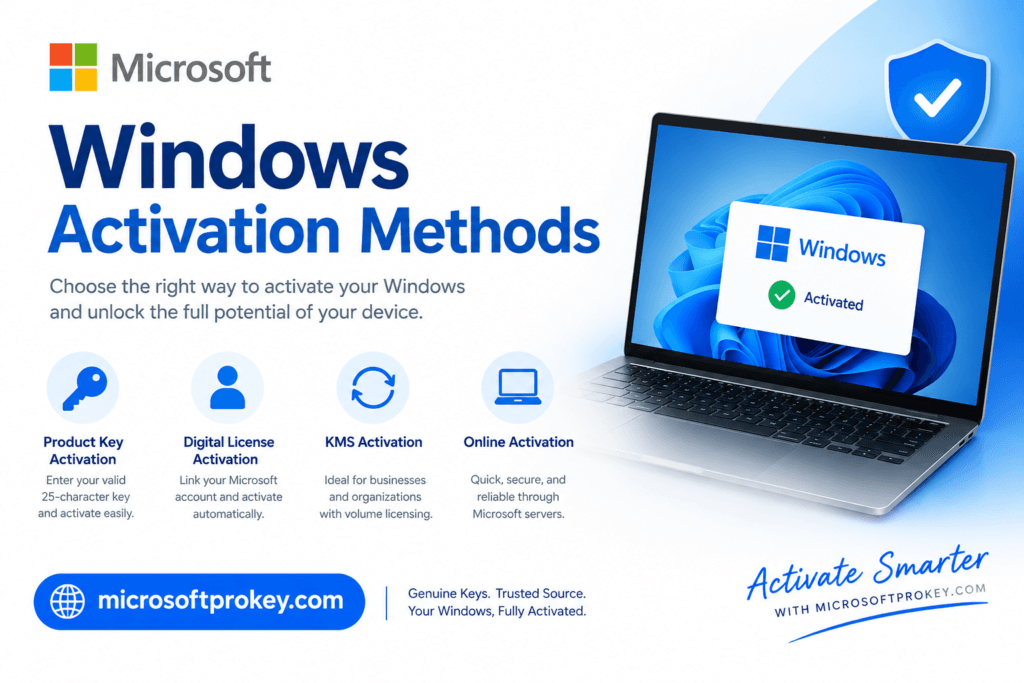
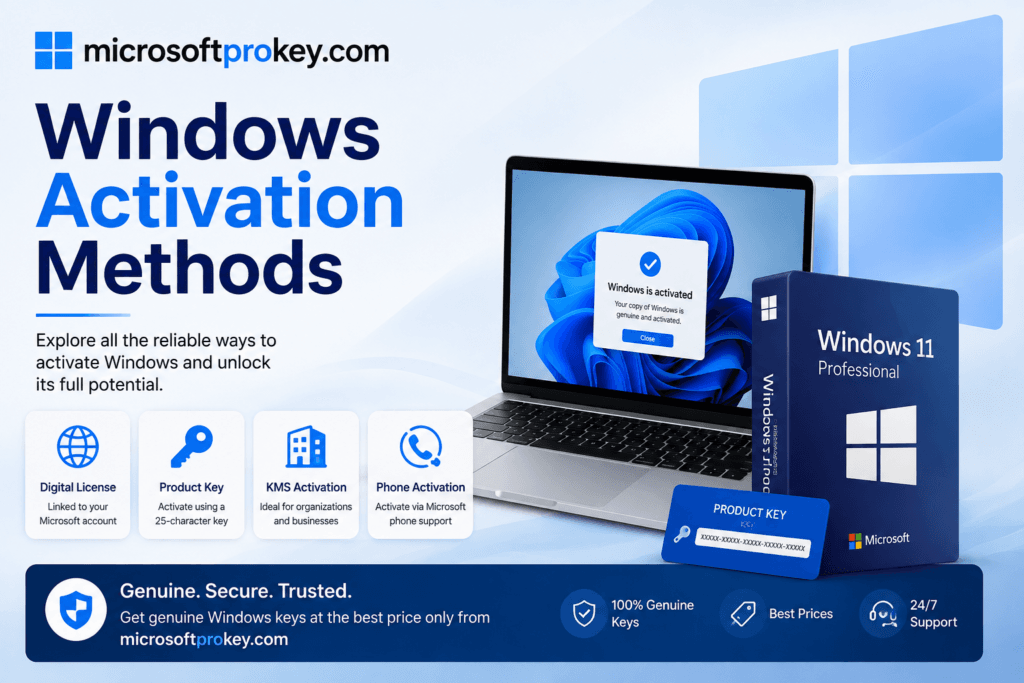
There are five main Windows Activation Methods available today. Each one works differently. Each one suits a different situation. The first method is HWID or digital license. This method is permanent. It ties your license to your hardware. The second method is KMS activation. This is for businesses. It uses a local server to activate many PCs. The third method is MAK. This stands for Multiple Activation Key. It is also for businesses. It gives a set number of activations. The fourth method is OEM activation. This comes with new computers. It is tied to the motherboard. The fifth method is Retail activation. This is what you buy in stores.
It is transferable to new PCs. Each of these Windows Activation Methods has pros and cons. Some are cheap. Others are expensive. Some are easy. Others are complex. You need to understand each one. That way, you can make an informed choice. We will explain how they work. We will also tell you who should use them. This knowledge will save you time and money. It will also keep your PC running smoothly.
Digital License (HWID) – The Permanent Solution
HWID stands for Hardware ID. It is also called a digital license. This is one of the best Windows Activation Methods for home users. It is permanent and reliable. When you activate using HWID, Microsoft records your hardware. They store a unique hash of your PC components. This hash acts like a fingerprint. It is tied to your motherboard and CPU. Once activated, you never need to activate again. Even if you reinstall Windows, it stays activated. Microsoft recognizes your hardware automatically. This method works for Windows 10 and Windows 11. It is the most popular method today. Many users prefer it because it is hassle-free.
You do not need to remember a product key. You do not need to enter anything manually. The activation happens in the background. It is seamless and invisible. However, HWID has one limitation. It is tied to your specific hardware. If you change your motherboard, you may lose activation. You might need to buy a new license. Despite this, HWID remains a top choice. It offers the best experience for most people. It is simple, secure, and permanent. That is why it dominates the market.
KMS Activation – Best for Businesses and Large Networks
KMS stands for Key Management Service. This is one of the most important Windows Activation Methods for organizations. Large businesses use KMS extensively. It works through a local server. This server sits inside the company network. It handles all Windows activations. PCs connect to this server to get activated. The activation lasts for 180 days. After that, PCs must reconnect to renew. This process is automatic. Users do not notice it. KMS is perfect for companies with many computers. It saves time and effort.
You do not need to enter keys on each PC. The server manages everything centrally. KMS also works for Office products. It is a comprehensive solution. However, KMS requires a minimum number of PCs. You need at least 25 computers. Otherwise, KMS will not work. This makes it unsuitable for home users. Small businesses may also find it excessive. KMS is also complex to set up. You need IT expertise. Despite this, it is very cost-effective. It reduces licensing costs significantly. Many global corporations rely on KMS. It keeps their systems running smoothly.
MAK (Multiple Activation Key) – For Volume Licensing
MAK is another enterprise-focused option. It stands for Multiple Activation Key. This is among the most flexible Windows Activation Methods for businesses. MAK works differently from KMS. You get a single product key. This key can activate a specific number of PCs. For example, you might buy a key for 100 activations. Each activation uses one count. Once you use all 100, the key stops working.
You can then buy more activations. MAK does not need a local server. You simply enter the key on each PC. The PC contacts Microsoft directly. This makes MAK simpler than KMS. It is also more portable. You can use it anywhere with internet. MAK is ideal for companies with remote workers. It also works for smaller organizations. You do not need 25 PCs. Even one PC can use MAK. However, MAK keys are more expensive per activation. They also require careful management. You must track how many activations you use. If you lose the key, you cannot recover it. Despite these challenges, MAK remains popular. It offers great flexibility. Many IT departments prefer MAK for its simplicity.
OEM Activation – Tied to Your Hardware
OEM stands for Original Equipment Manufacturer. This is one of the most common Windows Activation Methods for new computers. When you buy a PC from Dell, HP, or Lenovo, it comes with OEM Windows. The activation is pre-installed. It is tied to the motherboard. You do not need to do anything. The PC activates automatically when you connect to the internet. OEM licenses are cheap.
They cost much less than retail keys. That is why PC makers use them. However, OEM has major limitations. The license is not transferable. If your motherboard fails, you lose the license. You cannot move it to a new PC. You also cannot upgrade your motherboard easily. The license is locked to that specific machine. Additionally, Microsoft provides limited support for OEM. You must contact the PC maker for help. This can be frustrating. Despite these drawbacks, OEM is very popular. It is convenient and affordable. Most casual users do not notice the limits. They use their PC for years without issues. For them, OEM works perfectly fine.
Retail Key – The Traditional Purchase Option
Retail keys are what most people think of. They are the traditional Windows Activation Methods for consumers. You buy a box or a digital code. You enter the 25-character key during setup. The activation happens online. Retail keys are fully transferable. You can move them to a new PC. You just deactivate the old one first. This flexibility is a big advantage. Retail keys also come with Microsoft support.
You can call them for help. They also work for both Windows 10 and 11. Retail keys are more expensive than OEM. However, they offer more freedom. You can upgrade your hardware freely. You can also resell the license later. Many power users prefer retail keys. They value the portability. They also like the peace of mind. Retail keys never expire. They are permanent. Once activated, they stay activated. You do not need to renew anything. This makes them a great long-term investment. If you plan to keep your PC for years, retail is a solid choice. It gives you complete control over your license.
How to Choose the Right Windows Activation Method for You
Choosing among the Windows Activation Methods can be confusing. But it does not have to be. Start by asking yourself a few questions. First, who are you? Are you a home user? Are you a business owner? Are you an IT professional? Your answer matters a lot. For home users, HWID or Retail are best. HWID is easier and cheaper. Retail offers more flexibility. For small businesses, MAK is a good choice.
It is simple and works anywhere. For large enterprises, KMS is the way to go. It is cost-effective and scalable. For new PC buyers, OEM is already there. You do not need to choose. Next, consider your budget. OEM and HWID are cheaper. Retail and MAK cost more. KMS requires server setup costs. Also, think about your hardware plans. Do you upgrade often? If yes, choose Retail. Do you keep your PC for years?
Then OEM or HWID work fine. Finally, consider support needs. Retail gives you direct Microsoft support. OEM gives you PC maker support. KMS and MAK need internal IT support. By answering these questions, you can pick the right method. Remember, there is no one-size-fits-all. Choose what fits your situation best.
Introduction to Microsoft Teams Collaboration
Now let us shift gears. We will explore Microsoft Teams. Teams is a powerful collaboration tool. It is part of Microsoft 365. It brings people together. It combines chat, video, and file sharing. It also integrates with other Microsoft apps. Teams has become essential for modern work. It helps teams stay connected. It works for remote and office workers alike. The platform is very user-friendly. You can start using it quickly.
Teams offers many features. You can create channels for different topics. You can have private chats. You can host video meetings. You can share and edit documents together. All these features make collaboration easy. Teams also works on mobile devices. You can stay connected anywhere. Many companies use Teams daily. It has transformed how people work. It reduces email overload. It speeds up decision-making. It also improves transparency. Everyone can see what is happening. This builds trust and alignment. Teams is more than just a tool. It is a new way of working.
Microsoft Teams Use Case – Project Management and Teamwork
One major use case for Teams is project management. Teams provides a central hub for all project activities. You can create a dedicated team for each project. Within that team, you create channels. Each channel focuses on a specific aspect. For example, you might have a “Design” channel.
You might have a “Development” channel. You might have a “Marketing” channel. This keeps conversations organized. Everyone knows where to post. You can also use Planner within Teams. Planner helps track tasks and deadlines. You can assign tasks to team members. You can set due dates. You can track progress visually. This makes project management simple. Teams also integrates with SharePoint.
You can store all project files in one place. Everyone accesses the same version. No more emailing files back and forth. You can also co-edit documents in real-time. Multiple people can work on a Word file together. Changes appear instantly. This speeds up project delivery. It also reduces errors. Teams makes project collaboration seamless. It is a game-changer for teams.
Microsoft Teams Use Case – Remote and Hybrid Work
Remote work is here to stay. Teams is the perfect tool for it. It connects remote workers seamlessly. You can have video calls with anyone. You can share your screen to show work. You can use the whiteboard for brainstorming. All this happens in real-time. Remote workers feel included.
They are not left out of conversations. Teams also supports asynchronous work. You can leave messages in channels. Others can reply when they are available. This works across time zones. It is very flexible. Teams also has a mobile app. Remote workers can stay connected on the go. They can join meetings from anywhere. They can respond to messages quickly. This keeps productivity high. Teams also integrates with Outlook. You can schedule meetings directly. You can see everyone’s availability.
This removes the back-and-forth of scheduling. For hybrid work, Teams bridges the gap. Office workers and remote workers collaborate equally. Everyone uses the same platform. There is no “us vs them” feeling. Teams creates a unified work environment. It is essential for modern workplaces.
Microsoft Teams Use Case – Client Communication and Sales
Teams is not just for internal use. It is also great for client communication. Sales teams use Teams to connect with clients. They can host virtual demos. They can share proposals instantly. They can answer questions in real-time. This speeds up the sales cycle. Clients appreciate the quick responses. They also like the professionalism. Teams also integrates with CRM systems. You can track client interactions easily.
This helps you stay organized. You can also create shared channels with clients. This gives clients a dedicated space. They can ask questions there. They can review documents there. This improves transparency and trust. Client communication becomes smoother. Teams also supports large meetings.
You can host webinars for many clients. You can present to hundreds of people. This is great for product launches. Teams also records meetings automatically. Clients can watch them later. This is very convenient. Overall, Teams enhances client relationships. It makes communication faster and clearer. It is a valuable tool for any client-facing role.
Conclusion – Get Activated and Collaborate Better
We have covered a lot of ground today. We explored the various Windows Activation Methods in detail. We discussed HWID, KMS, MAK, OEM, and Retail keys. Each method has its own strengths. Each method suits a different user. Home users benefit from HWID or Retail. Businesses benefit from KMS or MAK. New PC buyers already have OEM. The key is to choose the right one for you. Do not settle for unactivated Windows.
It is not worth the risk. You lose features and security. You also look unprofessional. Instead, invest in a genuine license. It is a small price for peace of mind. For reliable and affordable keys, visit MicrosoftProKey. They offer genuine product keys at great prices. Their keys work perfectly. They also come with support. You can trust them for your activation needs.
Now, let us also remember Teams. Teams is a powerful collaboration tool. It helps teams work better together. It supports project management, remote work, and client communication. It is an essential tool for modern businesses. By combining genuine Windows activation with Teams, you set yourself up for success. You get a secure PC and a collaborative workspace. This is a winning combination. So, take action today. Activate your Windows properly. Start using Teams effectively. Your productivity will soar. Your team will thank you. Your clients will notice the difference. It is time to embrace the best tools available.
FAQ’s
Q1: What is the best Windows Activation Method for a home user?
The best method for home users is HWID or digital license. It is permanent and easy. You do not need to remember a product key. It activates automatically with your hardware. Alternatively, you can buy a Retail key for more flexibility.
Q2: Can I use KMS activation on my personal PC?
Technically, yes, but it is not recommended. KMS is designed for businesses with at least 25 PCs. It requires a local server. For personal use, HWID or Retail are much better choices.
Q3: How do I know which Windows Activation Method my PC uses?
You can check by opening the Settings app. Go to “Update & Security” and then “Activation”. It will show you the activation status and method. It might say “Digital license” or “Volume activation”.
Q4: Is it safe to buy Windows keys from MicrosoftProKey?
Yes, MicrosoftProKey is a trusted provider. They sell genuine product keys. Their keys work for activation. They also offer customer support. Many users have positive experiences with them. Always buy from reputable sources to avoid scams.
Q5: What happens if I do not activate Windows?
Your PC will work, but with limitations. You will see a watermark on your screen. You cannot change personalization settings. You may also miss some security updates. It is better to activate for full functionality and security.