Introduction
Windows activation is a vital step after you install the operating system. It confirms that your copy of Windows is genuine. It also unlocks all the features of the OS. Without activation, you face many limits. You cannot change your wallpaper. You see a watermark on your screen. You also miss important security updates. Therefore, understanding Windows Activation Methods is crucial for every user.
This guide explains all the Windows Activation Methods in simple terms. We will cover retail keys, OEM licenses, digital licenses, and volume activation. We will also talk about KMS and MAK. By the end, you will know which method suits your needs. You will also learn where to buy genuine keys. Let us start this journey together. We will make activation easy for you.
What Is Windows Activation and Why Does It Matter?
Windows activation is a process that verifies your license. It checks if your product key is valid. It also ensures that the key is not used on too many devices. Microsoft uses activation to fight piracy. This process protects both the company and the users. When you activate Windows, you get full access to the OS. You can personalize your PC. You can change themes and colors. You also receive all the latest updates.
These updates keep your system secure. Without activation, your PC feels limited. You will see constant reminders to activate. Some features stay locked. Therefore, activation is not just a formality. It is a necessity. There are many Windows Activation Methods available today. Each method serves a different purpose. Some are for home users. Others are for businesses. Choosing the right one saves you time and money. It also ensures that you stay compliant with Microsoft’s rules. So, let us explore each method in detail.
Retail Product Key Activation: The Classic Choice
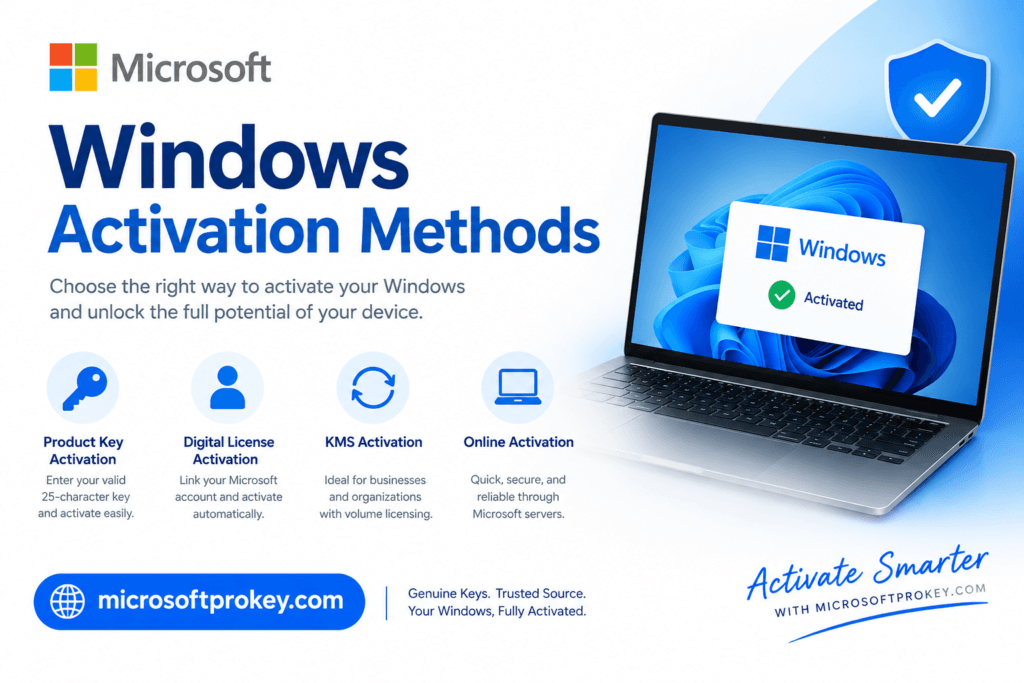
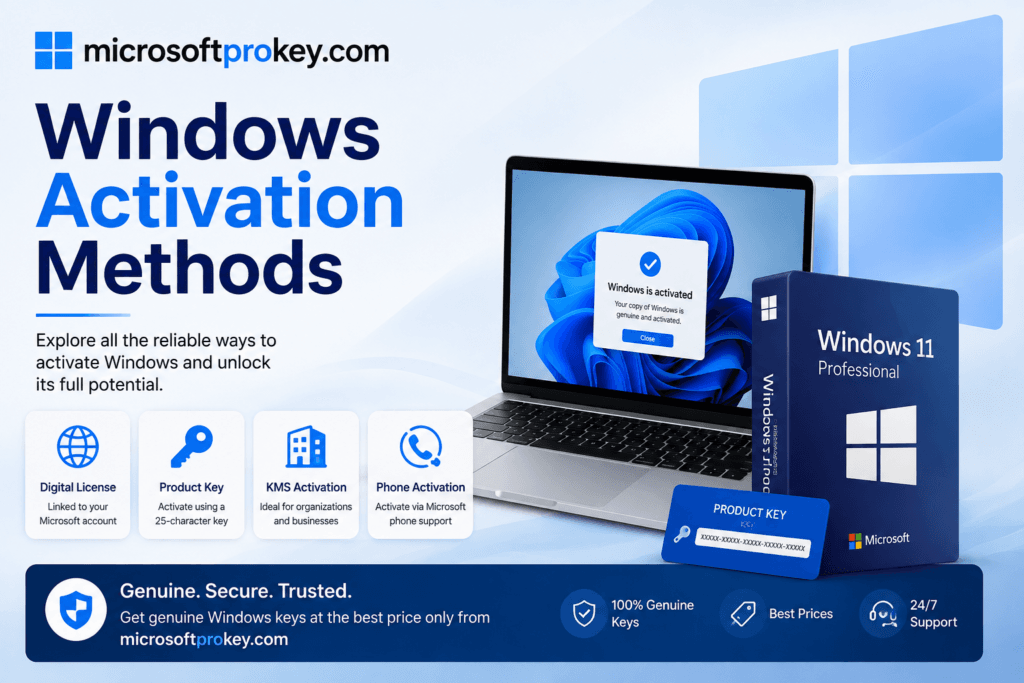
Retail product key activation is the most common method. You buy a 25-character key from a store. This key works for one PC at a time. You enter the key during installation. Or you enter it later in the Settings app. The key then connects to Microsoft’s servers. It validates your license. This is one of the simplest Windows Activation Methods for individuals. Retail keys are very flexible. You can transfer them to a new computer.
You just need to uninstall Windows from the old PC first. This makes retail keys a great investment. They are perfect for people who build their own PCs. They are also good for users who upgrade often. However, retail keys cost more than other options. You pay for the flexibility. But the peace of mind is worth it. You get direct support from Microsoft. You also get a clean, genuine license. Many online stores sell retail keys. But you must be careful. Only buy from trusted sources. Otherwise, you might get a fake key. Always verify the seller’s reputation before buying.
OEM Activation: The Pre-Installed Option
OEM stands for Original Equipment Manufacturer. This method is for PCs that come with Windows pre-installed. Brands like Dell, HP, and Lenovo use OEM licenses. You cannot move it to another PC. This is a key difference from retail keys. OEM activation happens automatically. The key is stored in the BIOS. When you install Windows, it reads the key. It activates without any input from you. This makes OEM one of the easiest Windows Activation Methods. You do not need to type any code. The process is smooth and quick.
OEM licenses are cheaper than retail keys. That is why PC makers use them. They save money on each device. But there is a downside. If your motherboard fails, you lose the license. You cannot transfer it to a new board. Also, Microsoft support is limited for OEM users. You must contact the PC maker for help. Despite these limits, OEM is very popular. It is a hassle-free way to get Windows. Most people never think about activation. It just works in the background.
Digital License Activation: The Modern Way
Digital license activation is a newer method. It is also called digital entitlement. This method links your license to your Microsoft account. It also links to your hardware. When you upgrade from Windows 7 or 8.1, you get a digital license. New PCs with Windows 10 or 11 also use this. The license is stored online. You do not need a product key. This is one of the most convenient Windows Activation Methods. You just sign in with your Microsoft account. Windows checks the servers. It verifies your license automatically.
This method is great for reinstallation. You can reinstall Windows on the same PC. The activation happens without a key. It saves you from losing your key. However, there are some limits. Major hardware changes can break the license. If you change the motherboard, you may need to reactivate. You can use the activation troubleshooter for this. Overall, digital licenses are user-friendly. They reduce the need for physical keys. They also make the process faster. Many users prefer this method today.
Volume Licensing: For Businesses and Organizations
Volume licensing is for large organizations. It is not for individual home users. Companies buy many licenses at once. They get special keys and tools. Volume licensing offers two main Windows Activation Methods. These are KMS and MAK. We will discuss both in detail. Volume licensing is cost-effective for big businesses. It simplifies management. IT admins can activate hundreds of PCs easily. They do not need to enter keys on each machine. This saves a lot of time. Volume licensing also offers better control.
Admins can track which devices are activated. They can also deactivate old devices. This helps with compliance. However, volume licensing is complex. It requires technical knowledge. It also needs proper infrastructure. Small businesses may not need it. But for enterprises, it is essential. Microsoft offers different volume programs. These include Open License and Enterprise Agreement. Each program has its own rules. Choose the one that fits your organization’s size.
KMS Activation: Key Management Service Explained
KMS stands for Key Management Service. This is a volume activation method. It uses a local server to activate PCs. The server is called a KMS host. Organizations set up this host on their network. Client PCs connect to this host. They get activation from the host, not from Microsoft. KMS is one of the most efficient Windows Activation Methods for large networks. It works well for environments with many devices. The activation is valid for 180 days. Clients must renew every 180 days. They do this automatically by connecting to the KMS host.
This keeps them activated. KMS requires a minimum number of devices. For Windows client, you need at least 25 devices. For servers, you need at least 5. This threshold ensures that the system is used properly. KMS is great for schools and government offices. It reduces internet traffic. It also works in offline environments. However, setting up KMS is not trivial. You need a dedicated server. You also need to configure DNS. But once set up, it runs smoothly.
MAK Activation: Multiple Activation Key Explained
MAK stands for Multiple Activation Key. This is another volume activation method. Unlike KMS, MAK does not need a local server. Each PC activates directly with Microsoft. The key has a set number of activations. For example, a MAK might allow 100 activations. Once you use all, you cannot activate more. MAK is one of the simpler Windows Activation Methods for volume licensing. It works like a retail key but for multiple PCs.
You enter the key on each PC. The PC then connects to Microsoft. It validates the key and activates. This method is good for isolated networks. It is also good for small volume deployments. You do not need a KMS host. You do not need to manage a server. However, you must track your activations. If you use too many, you run out. You can request more activations from Microsoft. But this takes time. MAK is less automated than KMS. But it is more straightforward. Many IT admins use MAK for remote offices. It is reliable and easy to understand.
Active Directory-Based Activation: The Enterprise Solution
Active Directory-Based Activation (ADBA) is an advanced method. It is for organizations that use Active Directory. This method activates Windows through the domain. It does not require a KMS host. The activation data is stored in Active Directory. When a domain-joined PC starts, it gets activation from the domain. This is one of the most seamless Windows Activation Methods.
The user does not see anything. It happens in the background. ADBA works well for large enterprises. It reduces the need for extra servers. It also simplifies management. Admins can manage activation through Group Policy. They do not need to worry about KMS thresholds. However, ADBA has some limits. It only works with volume license editions. It also requires Windows Server 2012 or later. Setting up ADBA is more complex than KMS. You need to configure the domain properly. But once set up, it is very reliable. Many large companies prefer ADBA. It integrates well with their existing infrastructure.
Subscription Activation: The Cloud-Based Model
Subscription activation is a newer method. It is for business editions of Windows. This method links activation to a Microsoft 365 subscription. When a user signs in with a work account, Windows activates. This is one of the most modern Windows Activation Methods. It simplifies license management. Companies do not need to manage keys. They just assign subscriptions to users.
The activation happens automatically. This method is great for remote work. Users can sign in from any device. Windows checks the subscription and activates. It works for Windows 10 and 11 Enterprise editions. It is also used for Windows 365 Cloud PCs. Subscription activation reduces overhead. IT admins spend less time on activation issues. However, it requires a stable internet connection. Users must sign in regularly. The license is tied to the user, not the device. This is different from other methods. It offers great flexibility for modern workplaces.
Phone Activation: The Declining Method
Phone activation was once a common method. Users would call Microsoft to activate. They would read a long installation ID. Microsoft would give a confirmation ID. This process was slow and tedious. Today, phone activation is being retired. Microsoft quietly ended this service in December 2025. This means you cannot use phone activation anymore. It is no longer one of the supported Windows Activation Methods.
The move to online activation is complete. This change affects users in areas with poor internet. But Microsoft wants to streamline the process. Online activation is faster and more secure. It reduces fraud and misuse. If you have a valid key, you can still activate online. The Settings app handles this easily. Phone activation is a thing of the past. We must adapt to the new ways. The good news is that online activation works well. It is reliable and quick. Most users will not miss phone activation.
Virtual Machine Activation: Special Considerations
Virtual machines (VMs) have special activation needs. A VM runs on virtualized hardware. It acts like a separate computer. Each VM needs its own license. You cannot use one license for multiple VMs. This is an important rule. There are specific Windows Activation Methods for VMs. You can use retail keys for VMs. You can also use volume licensing. KMS and MAK work with VMs too. However, you must track each VM separately.
Some VMs use digital licenses. This depends on the host environment. For example, Windows 365 Cloud PCs use subscription activation. For on-premises VMs, you need a proper license. You cannot use the host’s license for the VM. Microsoft has clear rules for this. Always check the licensing terms. If you run many VMs, consider volume licensing. It is more cost-effective. You can activate multiple VMs with one MAK. Or you can use KMS for your VM farm. Plan your VM activation carefully to stay compliant.
How to Choose the Right Windows Activation Method
Choosing the right method depends on your situation. For home users, retail or OEM are best. Retail gives you flexibility. OEM is cheaper but tied to one PC. Digital license is also great for home users. It is automatic and hassle-free. For small businesses, consider MAK. It is simple and does not need a server. For large organizations, KMS or ADBA are better. They offer scale and automation. Subscription activation is good for modern companies. It works well with cloud services. When choosing among Windows Activation Methods, consider your budget.
Retail keys cost more but offer transferability. OEM keys save money but are locked. Volume licensing has upfront costs but saves in the long run. Also, think about your technical skills. KMS and ADBA need IT expertise. Retail and digital licenses are user-friendly. Consider your internet access. Online methods need a connection. Offline methods like KMS work without internet. Finally, think about your future needs. Will you upgrade hardware often? Then choose a transferable license. Plan ahead to avoid problems.
Where to Buy Genuine Windows Keys
Buying genuine keys is very important. Fake keys cause many problems. They may stop working after a few months. They also put your PC at risk. Therefore, you must buy from trusted sources. Microsoft’s official store is the safest. But it is also the most expensive. Authorized retailers are also good. They sell genuine retail keys. For volume licensing, go through Microsoft partners. There is also a great option online. You can visit Microsoftprokey for affordable keys. They offer genuine product keys at good prices.
Their keys work with all Windows Activation Methods. They support Windows 10 and 11. They also offer Office keys. The process is simple. You buy the key, and they email it to you. Then you activate Windows using the key. It is fast and easy. Many users have had positive experiences. Always check reviews before buying. Avoid sellers with very low prices. If it seems too good to be true, it probably is. Stick with reputable sellers like Microsoftprokey.
Common Activation Errors and How to Fix Them
Activation errors can be frustrating. But most are easy to fix. One common error is 0xC004F074. This means the key is invalid. Double-check the key for typos. Another error is 0x8007232B. This happens with volume licensing. It means the KMS host cannot be found. Check your network settings. Error 0xC004C003 means the key is blocked. This often happens with fake keys. You may need to buy a new key. Sometimes, the activation troubleshooter helps. Go to Settings > Update & Security > Activation. Click Troubleshoot.
Windows will try to fix the issue. For digital licenses, sign in with your Microsoft account. This often resolves the problem. If you change hardware, use the troubleshooter. It lets you transfer the license. For KMS issues, check the server status. Ensure the KMS host is running. Also, check the DNS records. Most errors have simple solutions. Do not panic. Follow the steps carefully. If all else fails, contact Microsoft support.
Tips for a Smooth Activation Experience
A smooth activation saves time and stress. Here are some tips. First, always use a genuine key. Fake keys cause endless problems. Second, keep your key safe. Write it down or save it in a file. Third, link your license to a Microsoft account. This makes reactivation easier. Fourth, check your internet connection. Most Windows Activation Methods need the internet. Fifth, update Windows before activating.
Updates fix many bugs. Sixth, use the activation troubleshooter if needed. It is a powerful tool. Seventh, know your license type. This helps you troubleshoot. Eighth, back up your activation status. You can use third-party tools for this. Ninth, avoid using activation hacks. They are illegal and unsafe. Tenth, buy from trusted sellers. Sites like Microsoftprokey offer genuine keys. Follow these tips for a hassle-free experience. Activation does not have to be hard. With the right approach, it is simple. Enjoy your fully activated Windows.
FAQ’s
1. What is the difference between retail and OEM Windows Activation Methods?
Retail keys are transferable to a new PC. OEM keys are tied to the motherboard. You cannot move an OEM license. Retail costs more but offers flexibility.
2. Can I use Windows without activation?
Yes, but with limits. You cannot personalize your PC. You will see a watermark. You also miss some updates. It is better to activate fully.
3. How do I check which Windows Activation Method I am using?
Open Command Prompt as admin. Type slmgr /dlv. This shows your license type. It will say Retail, OEM, or Volume.
4. Is it safe to buy cheap Windows keys online?
It depends on the seller. Some sell genuine keys at low prices. Others sell fake or stolen keys. Always buy from trusted sources like Microsoftprokey.
5. What happens if I change my motherboard?
For retail keys, you can reactivate. For OEM keys, you lose the license. Digital licenses may also need reactivation. Use the troubleshooter to fix this.
Conclusion
Understanding Windows Activation Methods is essential for every PC user. We have covered many methods in this guide. We talked about retail keys, OEM licenses, and digital licenses. We also explored volume licensing with KMS and MAK. Each method has its own pros and cons. Retail keys offer flexibility and transferability. OEM keys are cheap but locked to one PC. Digital licenses are modern and automatic. Volume licensing is best for businesses.
KMS is great for large networks. MAK is simpler for smaller volume needs. ADBA is for Active Directory environments. Subscription activation is the future for cloud users. Phone activation is now retired. Virtual machines need special handling. Choosing the right method depends on your needs. Consider your budget, technical skills, and future plans.
Always buy genuine keys from trusted sources. Fake keys cause many issues. They may stop working. They also risk your security. For affordable and genuine keys, consider Microsoftprokey. They offer reliable product keys for Windows and Office. Their keys work with all the Windows Activation Methods we discussed. You get a genuine license at a good price. The process is quick and easy. Many customers trust them for their activation needs.
Activation is not just a technical step. It is about protecting your investment. It ensures you get all the features of Windows. It also keeps your PC secure. With the right method, activation is simple. You can do it in a few minutes. Follow the steps in this guide. Choose the method that fits you. Enjoy a fully activated Windows experience. No watermarks, no limits, just pure Windows. Thank you for reading this comprehensive guide. We hope it helped you. Now you can make an informed decision. Activate your Windows with confidence today.