Introduction
Windows activation is a process that verifies your copy of Windows is genuine. It also confirms that your license follows Microsoft’s rules. Without activation, you lose many features. You cannot change your wallpaper or themes. A watermark stays on your screen. You might also miss important security updates. Therefore, choosing the right Windows Activation Methods matters a lot. Many users get confused by the different options. Some try free tools that promise activation. But these tools are often unsafe. They can harm your computer. They may also break Microsoft’s terms of service. This guide explains all the legal Windows Activation Methods. It helps you pick the best one for your needs. We compare costs, benefits, and risks. By the end, you will know exactly what to buy. You will also learn where to find genuine keys at good prices. Let us start with the basics of Windows Activation Methods.
What Are Windows Activation Methods?
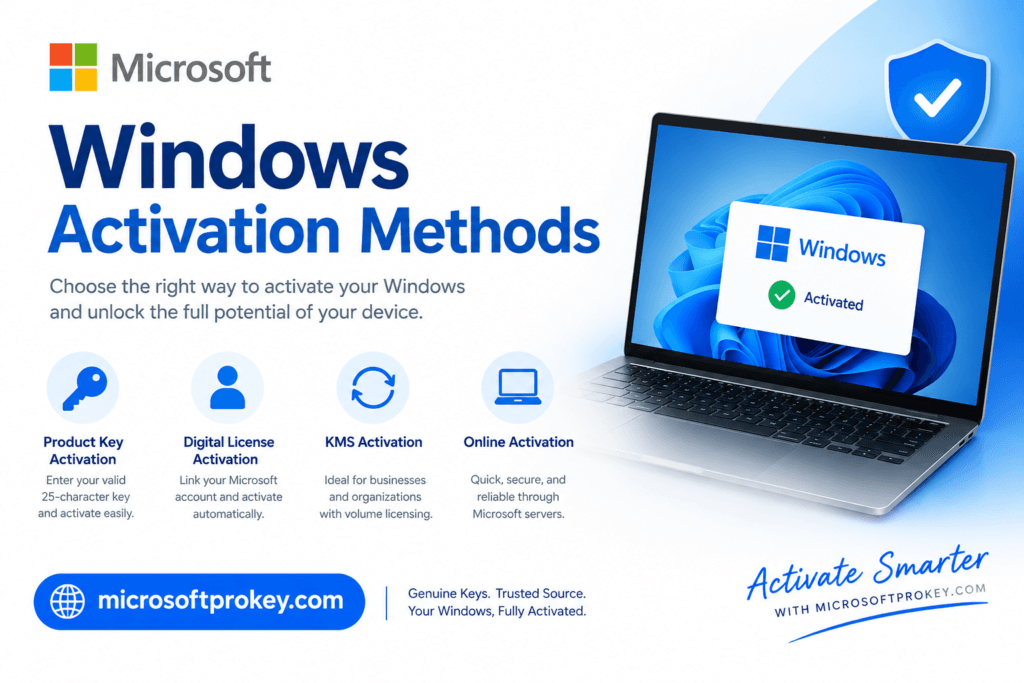
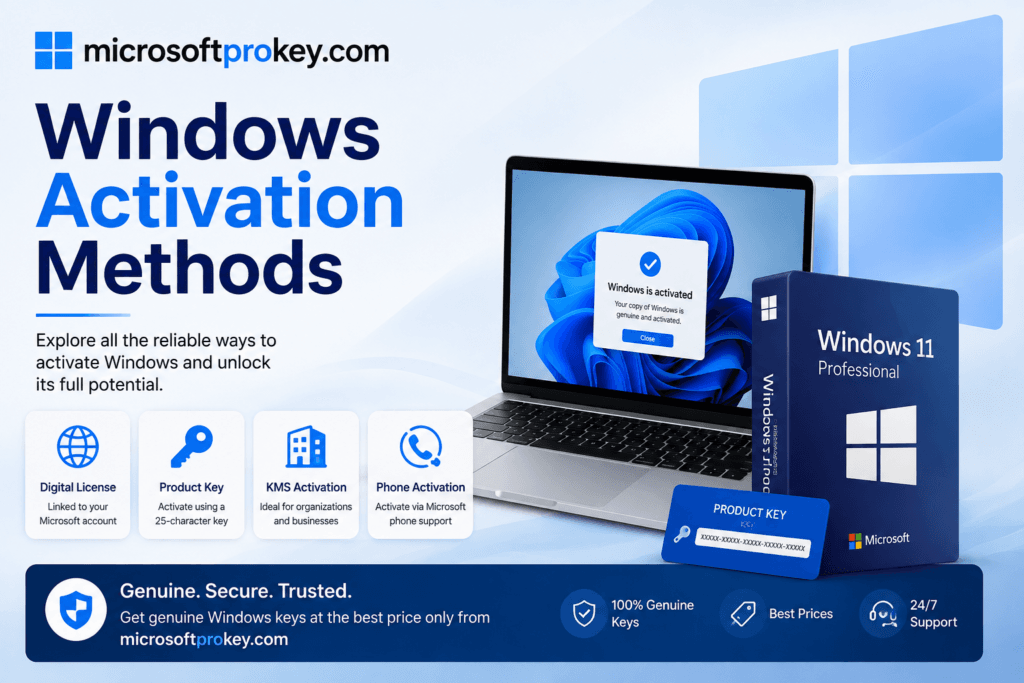
Windows Activation Methods are the official ways to activate your operating system. Microsoft offers several channels for activation. Each channel serves a different type of user. The main Windows Activation Methods include Retail keys, OEM keys, and Volume licenses. There is also the digital license method. This method links your license to your Microsoft account. Another method uses the Settings app directly. You can also activate during installation. Advanced users may use Command Prompt. Organizations often use KMS servers. Each of these Windows Activation Methods has unique rules. Some are transferable to new PCs. Others are tied to one motherboard. Understanding these differences is crucial. The right choice saves you money. It also prevents activation errors. We will explore each method in detail. This knowledge helps you make an informed decision. Let us examine the most common Windows Activation Methods first.
Retail Product Key Activation
Retail keys are the most flexible among Windows Activation Methods. You buy these keys from Microsoft or authorized retailers. They come in a box or as a digital download. The key is a 25-character code. You enter it during installation or in Settings. Retail keys are transferable. You can move them to a new computer. Just deactivate the old one first. This flexibility makes retail keys popular. They are ideal for people who upgrade PCs often. Retail keys also include Microsoft support. If you have issues, Microsoft helps you. However, retail keys cost more. Microsoft charges around $199 for Windows 11 Pro. Third-party sellers offer lower prices. But be careful with unofficial sellers. Some sell fake or stolen keys. Always buy from trusted sources. Retail activation is one of the safest Windows Activation Methods. It gives you full rights to the software. You also get access to all updates. For most home users, this is a great choice.
OEM Activation Explained
OEM stands for Original Equipment Manufacturer. These keys come pre-installed on new PCs. Brands like Dell, HP, and Lenovo use them. OEM activation is one of the most common Windows Activation Methods. The key is embedded in the motherboard firmware. Windows reads it automatically during setup. You do not need to enter a key manually. This makes installation very easy. However, OEM keys have a major limitation. They are tied to the first motherboard they activate on. You cannot transfer them to a new PC. If you change your motherboard, the license breaks. Microsoft does not offer support for OEM keys. You must contact the PC maker instead. The good news is OEM keys are cheap. Resellers offer them for $10 to $30. This makes them attractive for budget buyers. But remember the transfer restriction. If you plan to upgrade your PC later, avoid OEM. For a single fixed computer, OEM works fine. Among Windows Activation Methods, OEM is the most restrictive but cheapest.
Volume Licensing Activation
Volume licensing is for organizations. Businesses, schools, and government bodies use it. This method activates many computers at once. There are two main types under volume licensing. The first is MAK or Multiple Activation Key. The second is KMS or Key Management Service. Both are important Windows Activation Methods for enterprises. MAK keys have a set number of activations. Each activation is permanent. You use the key on a limited number of PCs. KMS works differently. It uses a local server on your network. Computers check in with this server every 180 days. If they do not check in, they deactivate. KMS is great for large fleets. It reduces the need for individual keys. Volume licenses are not for home users. Reselling them to individuals is often illegal. Microsoft does not support such transfers. If you buy a volume key as an individual, you take a risk. The key may be revoked later. Among Windows Activation Methods, volume licensing is the most complex. It requires technical knowledge to set up. Stick to retail or OEM for personal use.
Digital License Activation
Digital licenses are a modern form of activation. They link your license to your Microsoft account. This is one of the easiest Windows Activation Methods. You do not need a product key. The license is stored in the cloud. When you reinstall Windows, it activates automatically. Just sign in with your Microsoft account. This method works well for upgrades. If you upgraded from Windows 10 to 11, you likely have a digital license. It is also used for devices bought from the Microsoft Store. Digital licenses are tied to your hardware. But they are more flexible than OEM keys. If you change your motherboard, you can use the troubleshooter. It lets you transfer the license to new hardware. This makes digital licenses a good middle ground. They are convenient and user-friendly. Among Windows Activation Methods, digital licenses are becoming more common. They reduce the hassle of managing keys. However, you need a stable internet connection. The activation happens online. For most users, this is not a problem.
Activation via Settings App
The Settings app is the simplest way to activate Windows. This is one of the most user-friendly Windows Activation Methods. Open Settings and go to System. Then click on Activation. You will see your current status. If Windows is not activated, you see an option to enter a key. Click “Change product key.” Type your 25-character key. Then click Next and Activate. The process takes only a few seconds. This method works for both retail and OEM keys. It is also where you see your digital license status. The Settings app guides you through every step. It even links to the Microsoft Store. You can buy a license directly from there. This is the recommended way for most users. It is safe and official. Among all Windows Activation Methods, this is the most accessible. You do not need any technical skills. Just follow the on-screen instructions. If you have a valid key, activation is instant. This method also shows error messages. They help you troubleshoot problems.
Command Prompt Activation
Command Prompt is for advanced users. This is one of the more technical Windows Activation Methods. You use commands to install and activate keys. First, open Command Prompt as Administrator. Type “slmgr /ipk XXXXX-XXXXX-XXXXX-XXXXX-XXXXX.” Replace the Xs with your key. Press Enter to install the key. Then type “slmgr /ato.” This contacts Microsoft’s servers. It completes the activation. You see a confirmation message if it works. This method is useful for volume licensing. It is also helpful when the Settings app fails. Some users prefer it for batch installations. You can automate the process with scripts. However, be very careful. Typos in the command can cause errors. Always double-check your key. Command Prompt gives you more control. It also provides detailed status information. Type “slmgr /dlv” to see license details. This shows your activation type and expiry. Among Windows Activation Methods, this is the most powerful. But it requires some computer knowledge. Only use it if you are comfortable with commands.
KMS Activation for Enterprises
KMS activation is designed for large organizations. It is one of the most efficient Windows Activation Methods for businesses. KMS stands for Key Management Service. You set up a KMS host on your network. This host acts as a local activation server. Client computers connect to it. They receive a 180-day activation lease. Every 7 days, they renew the lease. This keeps them activated as long as they stay on the network. KMS requires a minimum number of computers. For Windows, you need at least 25 devices. For Office, you need at least 5. This method reduces internet bandwidth. It also centralizes license management. IT administrators love KMS for its control. You do not need individual keys for each PC. Instead, you use Generic Volume License Keys or GVLK. Microsoft publishes these keys publicly. They are not secret. The real license comes from your KMS server. Among Windows Activation Methods, KMS is the most scalable. But it is not for home users. Setting up a KMS server is complex. You need dedicated IT staff.
HWID Activation
HWID stands for Hardware ID activation. This is one of the newer Windows Activation Methods. Microsoft introduced it with Windows 10. It works behind the scenes. When you activate Windows, Microsoft creates a hardware hash. This hash is a fingerprint of your PC. It includes your CPU, motherboard, and storage. Microsoft stores this hash on their servers. When you reinstall Windows, the system checks this hash. If it matches, Windows activates automatically. You do not need to enter a key. This makes reinstalls very smooth. HWID is a form of digital license. It is tied to your hardware, not your account. However, you can link it to a Microsoft account too. This gives you extra flexibility. If you change your motherboard, the hash changes. Then HWID activation may fail. But you can use the activation troubleshooter. It lets you transfer the license. Among Windows Activation Methods, HWID is the most seamless. It is perfect for people who reinstall Windows often. You never have to find your key again.
Phone Activation
Phone activation is an older method. But it is still available. This is one of the backup Windows Activation Methods. Use it when online activation fails. You call Microsoft’s automated phone system. It gives you a installation ID. You enter this ID on your PC. Then the system gives you a confirmation ID. You type that in to complete activation. This method works for retail keys. It is also available for some OEM keys. Phone activation is useful in areas with poor internet. It is also a fallback for error codes. For example, error 0xC004C003 often requires phone activation. The process takes about 10 minutes. It is not as convenient as online methods. But it works when nothing else does. Among Windows Activation Methods, phone activation is the oldest. It has been around since Windows XP. Microsoft still supports it today. Keep your product key handy before you call. You will need to read it over the phone. This method is reliable and secure.
Activation During Installation
You can activate Windows during the installation process. This is one of the most straightforward Windows Activation Methods. When you boot from a USB or DVD, you see a setup screen. At one point, it asks for a product key. You can enter your key there. The installation then proceeds with that license. If you skip this step, you can activate later. Skipping is fine for most users. It lets you test Windows first. But entering the key during install saves time. It also ensures the correct edition is installed. For example, if you enter a Pro key, it installs Pro. If you skip, it installs Home by default. This method works for both retail and OEM keys. It is very common for clean installations. Many IT professionals use this method. It streamlines the setup process. Among Windows Activation Methods, this is the most proactive. You get activation out of the way early. Then you can focus on using your PC.
Microsoft Store Activation
The Microsoft Store offers another activation route. This is one of the most official Windows Activation Methods. Open the Store app from your Start menu. Search for “Windows 11” or “Windows license.” You see options to buy a digital license. The purchase links to your Microsoft account. Activation happens automatically after purchase. You do not need to enter a key. The license is stored in the cloud. This method is very secure. You know you are getting a genuine license. Microsoft backs it with full support. The price is the full retail price. But you avoid the risk of fake keys. This method is best for users who want simplicity. It is also good for those who trust Microsoft directly. Among Windows Activation Methods, this is the most legitimate. There is no third-party involved. However, it is also the most expensive. If you want to save money, consider other options. But always prioritize safety over savings.
Comparison of All Methods
Let us compare all the Windows Activation Methods side by side. Retail keys are flexible and transferable. They cost the most but offer full support. OEM keys are cheap but hardware-locked. They are non-transferable. Volume licenses are for organizations only. They are not for individual buyers. Digital licenses are convenient and cloud-based. They link to your Microsoft account. Settings app activation is the easiest method. Command Prompt is for advanced users. KMS is for large networks. HWID offers seamless reinstalls. Phone activation is a reliable backup. Installation activation saves time. Microsoft Store is the most official. Each method has pros and cons. Your choice depends on your budget and needs. If you upgrade PCs often, choose retail. If you have a single PC, OEM is fine. If you want convenience, go digital. Among all Windows Activation Methods, there is no single best. The best method is the one that fits your situation. Consider your long-term plans. Think about how often you change hardware. Then make your choice.
How to Choose the Right Method
Choosing among Windows Activation Methods requires careful thought. First, consider your budget. Retail keys are expensive but safe. OEM keys are cheap but restrictive. Second, think about your hardware plans. Do you upgrade your PC often? If yes, avoid OEM. Choose retail or digital instead. Third, assess your technical skills. Are you comfortable with Command Prompt? If not, stick to the Settings app. Fourth, consider support needs. Do you want Microsoft’s help? Then choose retail or Microsoft Store. Fifth, think about reinstallation. Do you reinstall Windows often? HWID and digital licenses make this easy. Sixth, check your organization type. Are you a business? Volume licensing may be right. Are you a home user? Retail or OEM are better. Seventh, consider internet access. Phone activation is good for offline situations. Eighth, evaluate risk tolerance. Cheap keys from unknown sellers are risky. Always buy from reputable sources. Among Windows Activation Methods, safety should be your top priority. A fake key can be revoked anytime. That wastes your money and time.
Where to Buy Genuine Keys Safely
Buying genuine keys is critical for all Windows Activation Methods. You have several safe options. The first is the Microsoft Store. It is the most official source. You get a digital license directly. The second is authorized retailers. These include Amazon, Best Buy, and Newegg. They sell retail boxed copies. The third is reputable online resellers. One such trusted source is Microsoftprokey. They offer genuine keys at competitive prices. Their keys work with all Windows Activation Methods. They provide instant delivery via email. Their customer support is responsive. Many users recommend them for affordable keys. Always check reviews before buying. Avoid sellers with extremely low prices. They often sell stolen or fake keys. These keys may activate temporarily. But Microsoft will eventually block them. That leaves you with a non-functional system. Stick to established sellers with good reputations. Among Windows Activation Methods, the key quality matters most. A good key ensures smooth activation. It also gives you peace of mind. Visit https://microsoftprokey.com/ for reliable keys. They have a wide selection for all Windows versions.
Legal and Security Considerations
Legal and security issues matter with Windows Activation Methods. Using unlicensed software is against Microsoft’s terms. It is also illegal in many countries. You could face fines or legal action. More importantly, unlicensed software is unsafe. It may contain malware. Hackers often distribute fake activation tools. These tools steal your personal data. They can also damage your system. Always use official Windows Activation Methods. They protect your privacy and security. Genuine Windows receives regular updates. These updates fix security vulnerabilities. Without them, your PC is at risk. Ransomware and viruses target unactivated systems. Do not take that risk. The cost of a genuine key is small compared to data loss. Investing in a proper license is wise. Among Windows Activation Methods, only official ones are safe. Avoid KMS pirates and activation scripts. They are not worth the danger. Always buy from trusted sources like Microsoftprokey. Your security depends on it.
Future of Windows Activation
The future of Windows Activation Methods is changing. Microsoft is moving towards digital licenses. More users will link licenses to their accounts. This makes activation easier and more secure. Hardware ID activation will become more common. Reinstalls will be completely seamless. Cloud-based activation reduces the need for keys. Subscription models may also grow. Windows 365 is already a subscription service. Some users may prefer this model. It includes activation as part of the service. However, traditional keys will remain for a while. Many users still prefer one-time purchases. Microsoft supports both models. The key is to stay informed. New Windows Activation Methods may emerge. TSforge is a new method for Server 2025. It offers permanent activation without expiry. But it is not for home users. As technology evolves, activation will get simpler. The goal is to make it invisible to users. You just use your PC without worrying about licenses. Among Windows Activation Methods, the trend is towards automation. The future is bright for legitimate users.
Cost Comparison of Methods
Cost is a major factor in choosing Windows Activation Methods. Retail keys from Microsoft cost around $199. This is the highest price. OEM keys from resellers cost $10 to $30. This is much cheaper. Volume licenses vary by organization. They are not for individual sale. Digital licenses from the Microsoft Store are $199 too. But you may get discounts during promotions. Third-party resellers offer lower prices. For example, Microsoftprokey sells keys at affordable rates. They offer Windows 11 Pro for a fraction of retail. Always compare prices before buying. But do not choose based on price alone. Consider the features and restrictions. A cheap OEM key may save money now. But it may cost you later if you upgrade hardware. A retail key costs more upfront. But it gives you flexibility for years. Among Windows Activation Methods, the total cost of ownership matters. Think long-term. A one-time purchase of a retail key is often better. It avoids future activation headaches. Invest wisely in your software.
Conclusion
Your choice depends on your budget, hardware plans, and technical skills. If you upgrade PCs often, choose retail or digital. If you have a single PC, OEM is fine. If you are a business, consider volume licensing. Always prioritize safety and legitimacy. Avoid fake keys and activation tools. They are risky and illegal. Buy from trusted sources. Microsoftprokey is a reliable option for genuine keys. They offer competitive prices and fast delivery. Their keys work with all Windows Activation Methods. Visit https://microsoftprokey.com/ to find the right key for you. Remember, a genuine license is an investment. It protects your data and ensures smooth operation. Do not compromise on quality. Choose wisely and enjoy a fully activated Windows experience. The right Windows Activation Methods make all the difference. They give you peace of mind and full functionality. Make the smart choice today.
FAQ’s
Q1: What are the most common Windows Activation Methods for home users?
The most common Windows Activation Methods for home users are Retail keys, OEM keys, and Digital licenses. Retail keys are bought from Microsoft or authorized sellers. They are transferable. OEM keys come pre-installed on new PCs. They are cheaper but tied to one motherboard. Digital licenses link to your Microsoft account. They activate automatically when you sign in.
Q2: Can I transfer my Windows license to a new computer?
It depends on which of the Windows Activation Methods you used. Retail keys are transferable. You can move them to a new PC. OEM keys are not transferable. They are locked to the original motherboard. Digital licenses can be transferred using the activation troubleshooter. Volume licenses are generally not for individual transfer.
Q3: Is it safe to buy cheap Windows keys from third-party sellers?
It can be safe if you buy from reputable sellers. Many third-party sellers offer genuine keys at lower prices. But you must be careful. Some sell fake or stolen keys. These keys may stop working later. Always check reviews and seller reputation. Microsoftprokey is a trusted source for genuine keys. Avoid extremely cheap offers that seem too good to be true.
Q4: What should I do if my Windows activation fails?
First, check your internet connection. Then go to Settings > System > Activation. Click Troubleshoot. This tool can fix many issues. If that fails, try the phone activation method. Call Microsoft’s automated system. Follow the instructions. If you still have problems, contact Microsoft support. Or visit Microsoftprokey for help with key issues.
Q5: Which of the Windows Activation Methods is the best value?
The best value depends on your needs. For most home users, a Retail key offers the best balance. It costs more upfront but gives full flexibility. You can transfer it to new PCs. For budget users, an OEM key is cheaper. But it is non-transferable. Digital licenses are also great value. They are convenient and easy to use. Compare the Windows Activation Methods and choose what fits your situation.